
Mount Elgon National Park protects about 1,121 sq km of mountain forest, bamboo, heath and high-altitude moorland in eastern Uganda, along the border with Kenya. At the centre of the park rises Mount Elgon, an ancient extinct volcano whose highest point, Wagagai Peak, reaches 4,321 metres above sea level. Unlike the sharp volcanic cones of some East African mountains, Mount Elgon has a broad summit area built around a vast collapsed caldera, with several peaks, caves, gorges and moorland spread across the upper mountain. The main reason to visit is hiking. Multi-day routes climb from Budadiri, Kapkwai and Kapkwata to Wagagai and the caldera, while shorter forest walks give travellers who do not want to summit a chance to explore waterfalls, caves, primates and mountain birdlife on the lower slopes.
The Sasa Trail is the most direct route to the summit, the Sipi Trail gives a longer and more gradual approach from Kapkwai, and the Piswa Trail offers a gentler ascent from the northern side. Mount Elgon also combines naturally with Sipi Falls, which lies outside the park but forms one of the best bases for exploring the wider mountain region. A good visit can therefore mix summit trekking or shorter forest hikes with waterfalls, Arabica coffee country and the highland scenery around Sipi and Kapchorwa. The mountain is best treated as an active trekking destination rather than a conventional wildlife safari park, with the strongest experiences coming from the changing altitude, vegetation and scenery as you climb.
Mount Elgon National Park Quick Facts
| Location | Eastern Uganda, along the Kenya border |
|---|---|
| Park Size | About 1,121 sq km |
| Highest Point | Wagagai Peak, 4,321 metres above sea level |
| National Park Since | 1993 |
| Bird Species | More than 296 recorded species |
| Main Experiences | Multi-day trekking, day hikes, forest walks, birding and caldera exploration |
Hiking Mount Elgon to Wagagai Peak
Hiking is the main reason to visit Mount Elgon National Park, with several routes climbing through montane forest, bamboo, giant heather and high-altitude moorland towards Wagagai Peak at 4,321 metres. The mountain is broad rather than sharply conical, so a Mount Elgon trek is not simply a continuous climb towards one summit. As you gain altitude, the trails cross ridges, valleys, caves, streams and open moorland before reaching the upper caldera and peaks. Most summit itineraries take between 3 and 6 days, depending on the route, walking pace and whether you descend on the same trail or cross the mountain using a different route. Do not choose a route only because it is shorter. The first-day elevation gain, distance between camps and time available to adjust to altitude all make a difference. The three routes most travellers compare are the Sasa, Sipi and Piswa trails, and each approaches the mountain from a different direction.
Sasa Trail
The Sasa Trail starts from Budadiri at about 1,250 metres and gives you the shortest and most direct traditional route towards Wagagai. It is also the steepest option. The first day alone can involve roughly 1,650 metres of elevation gain, including the climb through the Mudange Cliffs, so this is not the route I would choose simply because you have limited time. A complete ascent and descent can be done in 3 days, but 4 days is the more comfortable approach. The trail climbs rapidly from cultivated lower slopes into montane forest and then bamboo before reaching the higher moorland. As you move towards the summit area, the route passes Jackson’s Pool at about 4,050 metres, beneath the distinctive volcanic plug of Jackson’s Peak at about 4,165 metres, before continuing towards Wagagai. Choose Sasa if you are a reasonably strong walker, want the most direct ascent and are comfortable with a demanding first day. If you prefer a more gradual climb with more time to settle into the mountain, Sipi or Piswa will usually make more sense.
Sipi Trail
The Sipi Trail begins at the Forest Exploration Centre at Kapkwai, around 2,050 metres above sea level. Because you start roughly 800 metres higher than Budadiri, the initial climb is less abrupt than the Sasa approach. The route is longer, but the gradient is generally more gradual, making it a good choice for travellers who want to spend more time moving through the different vegetation zones rather than gaining most of their elevation immediately. The trail passes through forest and increasingly open mountain country as it climbs towards the upper slopes, with opportunities to include features such as Tutum Cave before continuing towards the caldera and summit area. The longer approach also makes it easier to appreciate how dramatically Mount Elgon changes with altitude, from dense vegetation on the lower slopes to giant heathers, lobelias, groundsels and open moorland higher up. I would favour the Sipi route for travellers who want a more gradual and scenic ascent, particularly when the trek is being combined with time around Sipi Falls and Kapkwai.
Piswa Trail
The Piswa Trail approaches Mount Elgon from Kapkwata on the northern side and is generally the gentlest of the three main traditional approaches. The route crosses forest, open mountain country and high moorland, with broad views towards the Karamoja plains and the Kenyan side of Mount Elgon as you gain elevation. Piswa suits hikers who prefer a steadier climb and want to experience a quieter side of the mountain rather than taking the most direct route. It also works well as part of a cross-mountain itinerary, where you ascend using one route and descend by another instead of retracing the same trail. Whichever route you choose, prepare for rapid weather changes. Conditions at 4,000 metres and above can be cold, windy and wet even when the lower slopes are warm. Carry waterproof protection and warm layers, and keep the day’s walking pace steady rather than trying to rush the climb. For most travellers, the choice is straightforward. Sasa is the shortest and steepest, Sipi is longer and more gradual, while Piswa offers the gentlest approach from the north. The best route is the one that fits your fitness, available days and preferred style of trekking, not simply the shortest line to Wagagai.
Wagagai Peak and the Mount Elgon Caldera
Wagagai Peak, at 4,321 metres, is the highest point on Mount Elgon, but the summit experience is about much more than standing at the top. Unlike a steep volcanic cone, Mount Elgon has a broad upper mountain formed around a huge collapsed caldera. The caldera is about 8 km across, with its floor lying around 3,500 metres above sea level, almost 800 metres below Wagagai. This creates an unusually open high-altitude landscape of moorland, rocky ridges, streams and volcanic features rather than a narrow summit ridge. As you approach Wagagai, the trail passes through some of Mount Elgon’s most distinctive scenery. Giant lobelias and groundsels become more common across the moorland, while exposed ridges give wide views over the caldera and surrounding peaks.
Nearby features include Jackson’s Peak at about 4,165 metres and Jackson’s Pool at roughly 4,050 metres, both reached along the upper Sasa route. Reaching Wagagai usually forms the high point of a multi-day trek, but I would not rush the summit simply to reduce the itinerary by a day. Weather can change quickly above 4,000 metres, with cold wind, cloud and rain moving across the upper mountain even when conditions lower down are clear. A steady pace also gives you more time to adjust to the altitude and appreciate the caldera rather than treating the summit as the only objective. For hikers, the real character of Mount Elgon becomes clear here. You are moving across the remains of an ancient volcano whose summit collapsed after major volcanic activity, leaving the broad caldera that defines the mountain today.
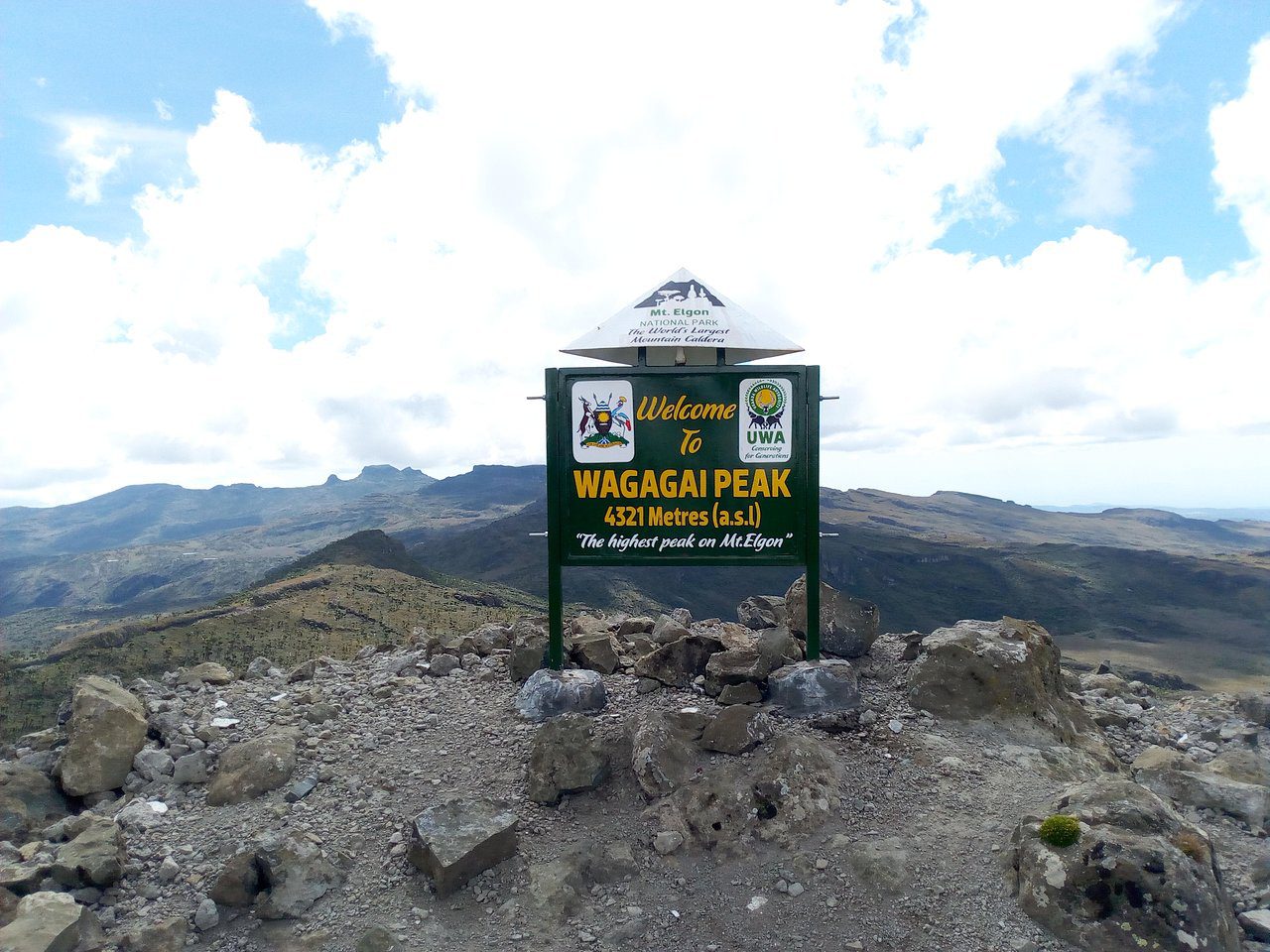
Wagagai Peak
Day Hikes and Forest Walks in Mount Elgon National Park
You do not need to climb Wagagai to experience Mount Elgon properly. The lower slopes have guided forest walks of different lengths, making the park practical for travellers who have only a morning or a full day rather than several nights for a summit trek. These walks move through montane forest, river valleys and bamboo country, with opportunities to see waterfalls, caves, viewpoints, monkeys and mountain birds along the way.
Kapkwai Forest Exploration Centre
The Kapkwai Forest Exploration Centre is one of the best starting points for shorter hikes. It lies on the edge of Mount Elgon National Park, about 13 km beyond Sipi, and also serves as the starting point for the longer Sipi route towards the upper mountain. From Kapkwai, you can choose shorter forest walks rather than committing to the multi-day climb. The walking here is very different from the exposed moorland around Wagagai. Trails pass through shaded forest where black-and-white colobus, blue monkeys and other primates may be encountered, while birders should keep binoculars ready because the lower forest supports a much wider variety of species than the open summit zone. Several routes also reach natural viewpoints where the forest opens towards the surrounding valleys and cultivated lower slopes. For a first visit without a summit trek, allow at least half a day around Kapkwai rather than trying to squeeze a forest walk between several other activities. Start in the morning when temperatures are cooler, and bird and primate activity is generally better.
Caves, Waterfalls and Viewpoints
Mount Elgon’s lower and middle slopes are cut by streams, cliffs and old lava formations, so many of the shorter walks are built around caves, waterfalls and natural viewpoints rather than a single summit objective. UWA’s visitor material specifically describes the Kapkwai walking routes as passing these features, which makes them useful for travellers who want the mountain experience without sleeping on the trail. Some longer routes continue towards features such as Tutum Cave, while the wider Kapkwai area includes access towards waterfalls and forest viewpoints. Conditions can become slippery after rain, particularly around streams and steep forest sections, so proper walking shoes are still important even on a short hike. These day walks work especially well when combined with Sipi Falls. You can spend one day exploring the national park forest from Kapkwai, then use another morning or afternoon for the waterfalls and coffee-growing landscape around Sipi rather than attempting to fit everything into one rushed outing.
Sipi Falls and Mount Elgon
Sipi Falls lies outside Mount Elgon National Park, but it is one of the strongest places to base yourself before or after hiking the mountain. The Sipi Valley sits immediately below the park boundary, where the Sipi River drops over three separate basalt cliffs as it descends towards the plains below. The result is a series of waterfalls, steep green slopes and deep valley views that feel very different from the enclosed forest and high moorland inside the national park. Most travellers stay around Sipi for at least one night because it gives easy access to waterfall walks, coffee experiences and the Kapkwai side of Mount Elgon. The main waterfall hike can be done as a half-day or longer outing depending on which sections you include and how much time you spend at the viewpoints. Trails can become slippery after rain, so proper walking shoes are important even if you are not doing a full mountain trek.
Sipi also works particularly well around a Mount Elgon itinerary because it gives you a useful recovery day before or after the summit. You can spend the morning walking between the waterfalls, then visit one of the Arabica coffee-growing areas on the lower slopes, where local guides explain how coffee is grown, processed and prepared. Coffee cultivation is a major part of the landscape around Sipi and the wider Elgon region. For travellers using the Sipi Trail, staying in the Sipi area is especially practical because the Kapkwai Forest Exploration Centre is nearby and serves as the trailhead for that route. If you are climbing via Sasa from Budadiri or Piswa from Kapkwata, Sipi is less important logistically, but it still makes a very good scenic stop before or after the trek.
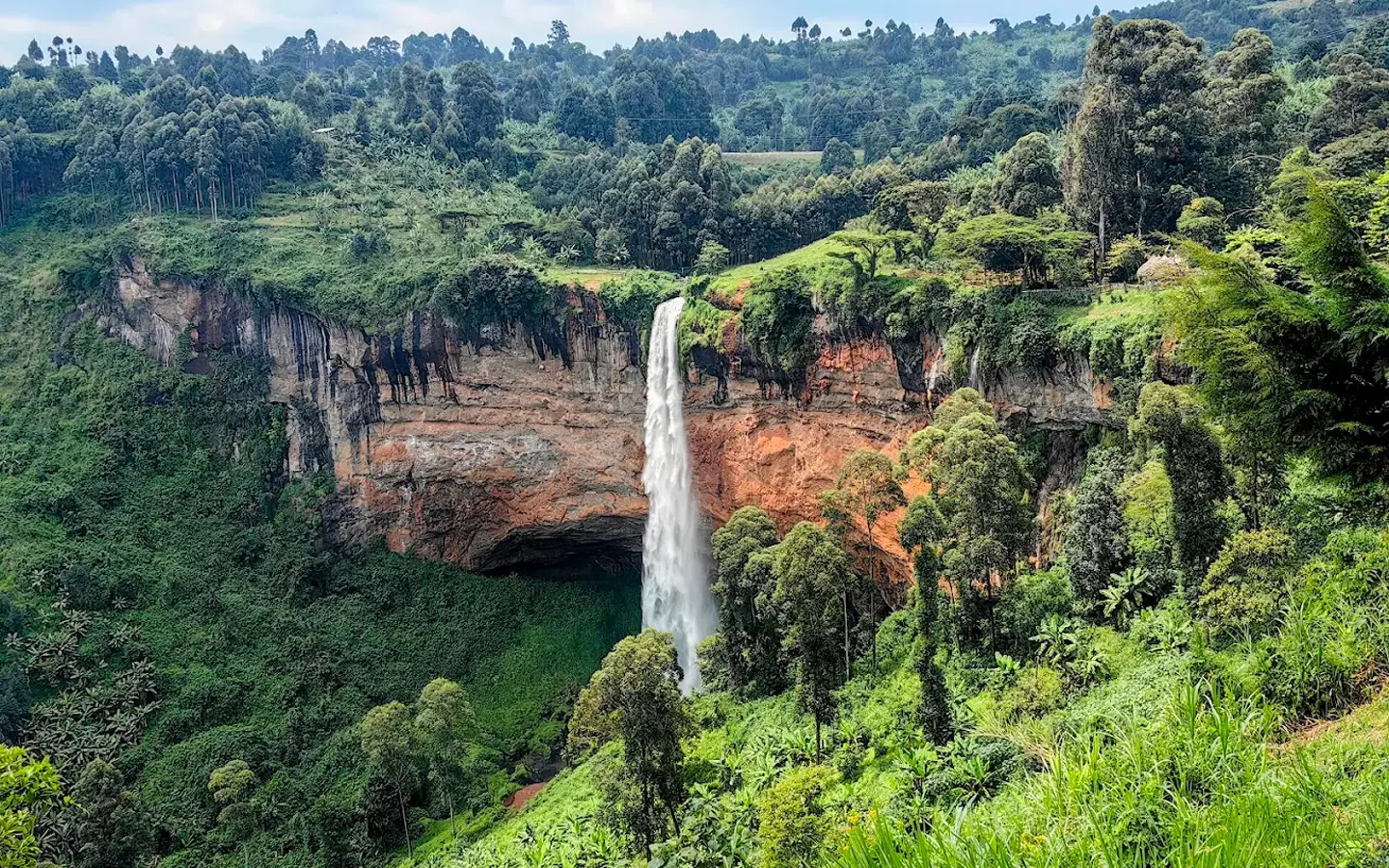
Sipi Falls
Birdwatching in Mount Elgon National Park
Mount Elgon supports more than 296 recorded bird species, with the strongest birding spread across the lower montane forest, bamboo zone and high-altitude moorland. The experience changes noticeably as you climb. Around Kapkwai and the lower forest, you are more likely to encounter forest and highland species, while the upper mountain brings birds adapted to open heath and moorland. This makes Mount Elgon particularly rewarding for travellers who are already hiking, because birding can be built naturally into the walk rather than treated as a completely separate activity. Among the more sought-after species are Jackson’s francolin, black-collared apalis and Hunter’s apalis, together with several sunbirds, turacos, hornbills and forest specialists.
The Kapkwai Forest Exploration Centre is one of the easiest places to begin because the trails pass through good forest habitat and can be covered without committing to a summit trek. For serious birders, start early in the morning when activity and calling are strongest. Binoculars are essential because many birds remain high in the canopy, particularly in the forested sections. If birding is not your main reason for visiting, you will still encounter plenty of species naturally on the Sasa, Sipi and Piswa routes, especially where the vegetation changes with altitude. Mount Elgon’s birding is therefore best appreciated as part of the mountain itself. A slow forest walk around Kapkwai will usually produce far more than trying to identify birds while rushing towards the summit.
BaMasaba, Sabiny and Coffee Experiences
The lower slopes of Mount Elgon are home to long-established BaMasaba and Sabiny communities, and the mountain is closely tied to local identity, farming and everyday life. The BaMasaba, also known as the Bagisu, traditionally refer to Mount Elgon as Masaba, linking the mountain directly with their ancestral history. Around Sipi and Kapchorwa, the Sabiny are equally important to the cultural landscape, particularly across the higher eastern slopes. For travellers, the most practical cultural experience is usually a community-led coffee visit around Sipi. The lower slopes are well suited to Arabica coffee, and local visits can take you through the full process from growing and harvesting to drying, roasting and preparing the final cup. This works especially well as a lighter activity before or after a demanding mountain trek. The value of these visits is not in adding another stop to the itinerary, but in understanding how people live around the mountain today. Farming, coffee production and local knowledge of the slopes all help explain why Mount Elgon is more than a hiking destination.

Holding coffee beans
Mount Elgon National Park Fees
| Visitor Category | Adult Park Entry |
|---|---|
| Foreign Non-Resident | US$35 |
| Foreign Resident | US$25 |
| East African Citizen | UGX 20,000 |
How to Get to Mount Elgon National Park
Mount Elgon National Park lies about 235 km east of Kampala, with Mbale serving as the main gateway to the mountain. The road from Kampala to Mbale is surfaced, and the route continues towards Kapchorwa and Sipi before smaller roads branch off towards the different hiking trailheads. The important thing to understand is that Mount Elgon does not have one single entrance for every trek. Your final approach depends on whether you are using the Sasa, Sipi or Piswa route. Budadiri and the Sasa Trail: For the Sasa Trail, travel from Mbale towards Budadiri, where the main ascent begins. This is the most practical approach for hikers choosing the shortest and steepest route towards Wagagai.
Sipi and Kapkwai: For the Sipi Trail, shorter forest walks and the Kapkwai Forest Exploration Centre, continue through Mbale towards Kapchorwa and Sipi. Kapkwai lies about 13 km beyond Sipi and is the main starting point for the Sipi route and several lower-slope nature walks. Kapkwata and the Piswa Trail. The Piswa Trail begins from Kapkwata on the northern side of the mountain, so this approach requires a different road route from the Sasa or Sipi trailheads. It is best planned specifically around the trek rather than treating all Mount Elgon access points as interchangeable. For most visitors, the easiest rule is simple. Choose your hiking route first, then choose the trailhead and accommodation around that route. This avoids unnecessary transfers across the mountain before or after a demanding trek.
Where to Stay Around Mount Elgon National Park
Where you stay around Mount Elgon should depend on the trail you are using and what you intend to do. Sipi, Budadiri and Mbale serve different purposes, while multi-day hikers sleep at basic mountain camps once the trek begins. Choosing accommodation around your starting point avoids unnecessary transfers before an early hike.
| Area | Best For | What to Expect |
|---|---|---|
| Sipi | Sipi Trail, Kapkwai forest walks, Sipi Falls and coffee experiences | The most convenient base for travellers combining Mount Elgon with Sipi Falls. It has a wider range of places to stay and provides access towards Kapkwai Forest Exploration Centre, about 13 km from Sipi. |
| Budadiri | Sasa Trail departures | The practical base for hikers taking the shortest and steepest route towards Wagagai. Accommodation is generally simpler, but staying here allows you to begin the Sasa Trail in the morning without a long transfer. |
| Mbale | Pre-trek and post-trek overnight stays | Offers the widest choice of hotels and is useful when arriving from Kampala, resting after the mountain or connecting to Budadiri, Sipi and other Mount Elgon approaches. |
| Mountain Camps | Multi-day Wagagai and caldera treks | Once you are on the mountain, overnight stays are at designated trekking camps rather than conventional lodges. Facilities are basic, so sleeping equipment, meals and trekking logistics need to be organised in advance. |
What to Pack for Mount Elgon Hiking
What you carry on Mount Elgon should reflect the altitude and the length of your trek. Conditions on the lower slopes can be warm and humid, but temperatures fall quickly as you climb towards the moorland and Wagagai Peak at 4,321 metres. Rain, cold wind and wet trails are possible even when the day starts clear, so proper clothing and footwear matter more than carrying a large amount of unnecessary gear. For a day hike around Kapkwai or the lower forest, you can travel relatively light. Multi-day summit treks need additional warm clothing, sleeping equipment and personal trekking gear for nights on the mountain. A practical Mount Elgon packing list should include:
- Waterproof hiking boots with good grip for muddy forest trails, wet rocks and uneven mountain ground.
- Waterproof jacket and trousers for rain and exposed sections of the upper mountain.
- Warm layers, including a fleece or insulated jacket, for early mornings, evenings and elevations above 3,000 metres.
- Warm hat and gloves, particularly for summit days when temperatures can be much colder than on the lower slopes.
- Lightweight walking trousers and moisture-wicking shirts rather than heavy cotton clothing that takes longer to dry.
- Daypack with a rain cover for water, snacks, camera equipment and clothing needed during the day’s walk.
- Refillable water bottle or hydration system so you can carry enough drinking water between stopping points.
- Headlamp or torch for early starts and evenings at mountain camps.
- Sun protection, including sunscreen, sunglasses and a hat, because exposure increases as the forest gives way to open moorland.
- Sleeping bag and suitable sleeping equipment for multi-day treks using the mountain camps.
- Personal medication and a small first-aid kit, including treatment for blisters, which can quickly become uncomfortable on consecutive hiking days.
Keep your main trekking bag as light as practical. On a multi-day climb, arrange porter support where needed rather than carrying everything yourself. You will enjoy the mountain much more when your daypack contains only the items you need while walking. The most important point is to pack for both warm lower slopes and cold, wet high-altitude conditions. Mount Elgon covers several vegetation and climate zones in a single trek, so clothing that can be added or removed in layers works far better than relying on one heavy jacket.
Best Time to Visit Mount Elgon National Park
The best time to visit Mount Elgon National Park for hiking is during the drier periods from December to March and from June to August. Trails are generally firmer during these months, river crossings are easier, and the upper slopes are more comfortable for multi-day trekking towards Wagagai Peak and the caldera. December to March is particularly good for summit trekking. The lower forest remains green, while reduced rainfall makes the steep sections of the Sasa Trail and the longer Sipi and Piswa approaches easier underfoot. June to August is another strong period for hiking, especially if Mount Elgon is being combined with other destinations in Uganda.
The wetter periods, particularly March to May and around September to November, bring heavier rainfall to the mountain. Mount Elgon remains open, but forest trails become muddier, and the upper slopes can be colder, wetter and more exposed. Short forest walks around Kapkwai are still possible, although proper waterproof clothing and boots with good grip become even more important. Rain can occur on Mount Elgon at any time of year because conditions change quickly with altitude. Even during the drier months, carry a waterproof jacket and warm layers when heading towards the upper mountain. For most travellers planning a Wagagai summit trek, choose January to February or June to August. If your visit is focused on Sipi Falls, coffee experiences, birding and shorter forest walks, Mount Elgon can be visited throughout the year with the right clothing and footwear.