
Kibale National Park protects about 795 sq km of tropical forest, woodland, grassland and wetland in western Uganda, roughly 35 km south of Fort Portal. It is Uganda’s main chimpanzee tracking destination and one of the richest primate forests in Africa, with 13 primate species recorded across the park. The latest wildlife assessment estimated about 1,415 chimpanzees in Kibale in 2025, alongside Uganda red colobus, black-and-white colobus, L’Hoest’s monkeys, red-tailed monkeys and mangabeys. Most visitors come for chimpanzee tracking from the Kanyanchu area, where standard treks run in morning and afternoon sessions and allow up to one hour with the chimpanzees once they are located. Travellers wanting a longer forest experience can choose the Chimpanzee Habituation Experience, while nearby Bigodi Wetland Sanctuary, forest birding and the Fort Portal crater-lake region give good reasons to stay for more than one night. Kibale also fits naturally before or after Queen Elizabeth National Park, making it one of the easiest primate destinations to include in a western Uganda safari.
Kibale National Park Quick Facts
| Location | Western Uganda, about 35 km south of Fort Portal |
|---|---|
| Park Size | About 795 sq km |
| Chimpanzees | About 1,415 estimated in 2025 |
| Primate Species | 13 recorded species |
| Main Trekking Area | Kanyanchu |
| Main Experiences | Chimpanzee tracking, habituation, birding, forest walks and Bigodi Wetland |
Chimpanzee Tracking in Kibale National Park
Chimpanzee tracking is the main activity in Kibale and normally starts from the Kanyanchu Visitor Centre, where you report for registration, briefing and assignment to a ranger-led group before entering the forest. Current tracking departures are scheduled for around 8:00 am, 11:00 am and 2:00 pm, and the complete experience usually takes about 2 to 5 hours, depending on where the chimpanzees have moved, trail conditions and how quickly the group is located. Once you reach the habituated chimpanzees, you are allowed up to one hour with them. Tracking groups are kept small, with a maximum of six visitors, and participants must be at least 16 years old.
What to Expect on a Chimpanzee Trek
Unlike gorilla trekking, where the group may remain relatively settled once located, Kibale’s chimpanzees can move quickly through the forest, feed high in the canopy and occasionally travel considerable distances before coming down to the ground. You may first hear their pant-hoots, screams and drumming on tree buttresses before you actually see them. Some encounters involve following a moving community through the forest, while on other days the chimpanzees may spend longer feeding or resting in one area. Wear closed hiking shoes with good grip, long trousers and light rain protection, and carry drinking water because Kibale remains humid and showers can occur at any time. Binoculars are useful when the chimpanzees are feeding high in the trees, while a camera without flash is better for photography. For planning, I would keep the rest of the day flexible. A morning trek can finish early enough for an afternoon Bigodi Wetland walk, but because the chimpanzees determine how long the tracking takes, avoid scheduling another activity immediately after your expected return time.
Kibale Chimpanzee Permit Prices
| Permit Type | Foreign Non-Resident | Foreign Resident | Rest of Africa | East African Citizens |
|---|---|---|---|---|
| Chimpanzee Tracking Effective 1 January 2027 |
US$300 | US$200 | US$100 | UGX 180,000 |
| Low-Season Chimpanzee Tracking April, May and November |
US$200 | US$150 | Not listed | Not listed |
| Chimpanzee Habituation Effective 1 January 2027 |
US$400 | US$300 | US$250 | UGX 250,000 |
Low-season chimpanzee tracking permits apply in April, May and November and cannot be rescheduled.
Chimpanzee Habituation Experience in Kibale
The Chimpanzee Habituation Experience is the better choice for travellers who want more time in the forest and a deeper look at chimpanzee behaviour than standard tracking allows. The day starts from around 6:30 am, much earlier than the regular tracking sessions, and follows a semi-habituated chimpanzee group as it moves, feeds, rests and interacts through the forest. Once the chimpanzees are located, visitors can spend up to 4 hours with them, compared with one hour on the standard trek. The experience can take most of the day, so it is better suited to travellers who are comfortable with several hours of walking on humid forest trails. Some periods are active, with the chimpanzees moving quickly through the canopy or across the forest floor, while other moments are slower and give more time to watch grooming, feeding and social behaviour. Carry enough water, wear proper hiking shoes and light rain protection, and avoid scheduling another major activity that afternoon. For keen photographers, primate enthusiasts and travellers who want something more immersive than the standard one-hour encounter, habituation is usually the stronger option.
Primates and Wildlife in Kibale National Park
Chimpanzees are the main reason travellers come to Kibale, but the forest supports 13 primate species, making ordinary walks and chimpanzee treks rewarding even before the chimpanzees are located. Among the species you may encounter are Uganda red colobus, black-and-white colobus, L’Hoest’s monkeys, red-tailed monkeys, blue monkeys, grey-cheeked mangabeys and olive baboons. Red colobus are particularly important here because Kibale protects one of Uganda’s strongest remaining populations. Several monkey species can occur in the same part of the forest, so it is worth carrying binoculars and paying attention to movement high in the canopy rather than concentrating only on the chimpanzees. Kibale also holds forest elephants, bush pigs, duikers and other forest mammals, although this is not a park where you should arrive expecting conventional game viewing. Elephants are present in significant numbers but usually move through thick vegetation, making encounters far less predictable than on the open plains of Queen Elizabeth or Murchison Falls. Leopards also occur in the forest but are rarely seen by visitors. The wildlife experience here is therefore best understood as primate and forest wildlife viewing, with the smaller details, calls in the canopy, tracks on the trail and occasional larger-mammal encounters becoming part of the experience rather than the focus of the visit.
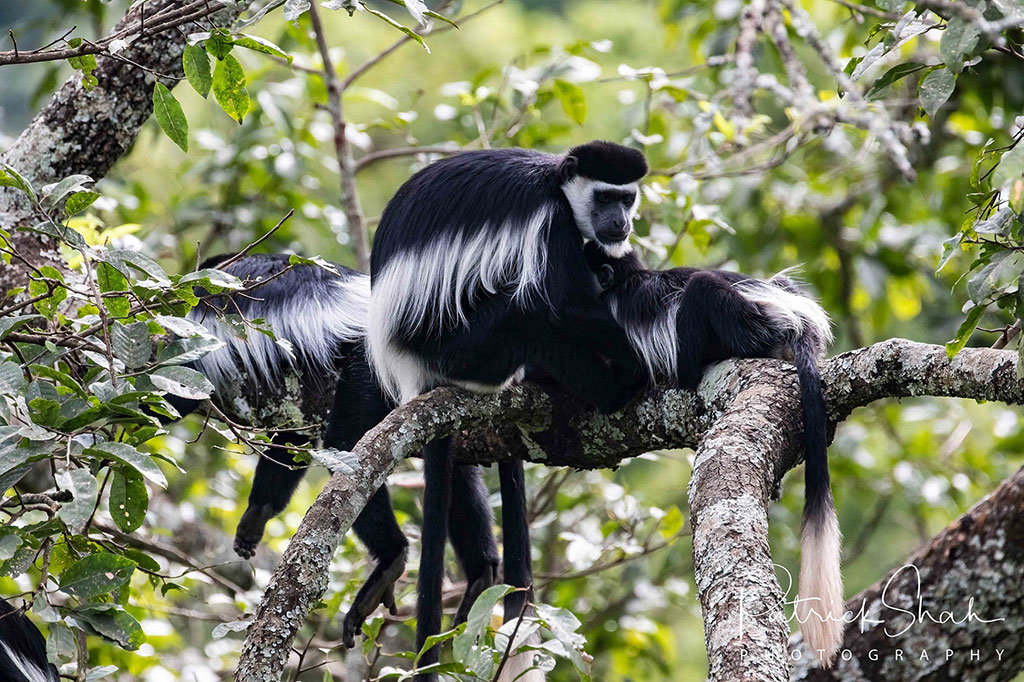
black-and-white colobus
Things to Do in Kibale Beyond Chimpanzee Tracking
Chimpanzee tracking is the main reason most travellers come to Kibale, but it should not be the only experience you plan around the forest. The strongest additions are Bigodi Wetland Sanctuary, birdwatching and guided forest walks, all of which show a different side of the Kibale landscape without competing with the main chimpanzee experience.
Bigodi Wetland Sanctuary
Bigodi Wetland Sanctuary lies just outside Kibale and is one of the easiest activities to combine with chimpanzee tracking. The main guided route follows about 4.5 km of forest-edge trails, wetland paths and boardwalk sections and normally takes around 2 to 3 hours. Bigodi is particularly good for primates such as red colobus, black-and-white colobus, red-tailed monkeys and grey-cheeked mangabeys, while the Great Blue Turaco is one of the birds most visitors hope to see. The sanctuary is only about 4 to 5 km from Kanyanchu, so a morning chimpanzee trek can be followed by an afternoon Bigodi walk without creating a rushed transfer. This is one of the most practical full-day combinations in Kibale because the two activities feel completely different. Chimpanzee tracking is focused and fast-moving, while Bigodi is slower and gives more time to watch monkeys, birds and wetland wildlife.
Birdwatching in Kibale National Park
Kibale has about 370 recorded bird species, and the forest trails around Kanyanchu and Sebitoli are the main places to look for forest specialists. The green-breasted pitta is one of the most sought-after birds, while species such as blue-headed bee-eater, Nahan’s francolin, African grey parrot and several forest hornbills add to the variety. Serious birders should give Kibale a separate morning rather than trying to identify birds while concentrating on chimpanzees. Bigodi then complements the forest birding well because it adds wetland and forest-edge habitat to the same stay.
Forest and Nature Walks
Guided nature walks from Kanyanchu are useful when you want to experience Kibale without the pressure of locating chimpanzees. Standard walks last around two hours and depart at approximately 8:00 am, 10:00 am and 2:00 pm. They focus more broadly on trees, monkeys, birds, butterflies, tracks and smaller forest wildlife. Kibale also offers night walks from around 7:30 pm to 10:00 pm, when the forest changes completely and the focus shifts towards nocturnal species such as bushbabies, pottos and other animals that are difficult to encounter during the day.
How to Get to Kibale National Park
Kibale is straightforward to reach by road from Kampala, Fort Portal and the other western Uganda safari parks. Kanyanchu is the main visitor area for chimpanzee tracking, so when comparing routes or accommodation, use Kanyanchu rather than the park boundary as your practical arrival point.
| Route | Distance / Travel Time | Practical Planning |
|---|---|---|
| Kampala to Kibale via Fort Portal | About 326 km, around 6 hours | The main road route. Travel west through Mubende and Fort Portal before continuing south to Kanyanchu. Allow extra time for traffic and stops. |
| Entebbe to Kibale | Around 6 to 7 hours by road | Similar western route, but allow additional time for the journey from Entebbe around Kampala before continuing towards Fort Portal. |
| Fort Portal to Kanyanchu | About 35 km, roughly 45 minutes to 1 hour | The easiest approach to the main chimpanzee tracking area. Staying near Kanyanchu reduces the early-morning transfer for an 8:00 am trek. |
| Queen Elizabeth National Park to Kibale | Roughly 2 to 3 hours, depending on your starting area | A practical connection when combining chimpanzee tracking with game drives and the Kazinga Channel in Queen Elizabeth National Park. |
| Entebbe or Kajjansi to Kasese | About 1 hour by air, then roughly 2 hours by road | The most practical fly-in option. Kibale does not have a scheduled commercial airstrip inside the park. |
| Charter Flight to Fort Portal | Around 1 hour 30 minutes by air, followed by road transfer | Useful for private or time-sensitive itineraries. Flight availability should be confirmed before building the safari around this option. |
Where to Stay Near Kibale National Park
For chimpanzee tracking, location matters more than simply choosing a lodge category. The main briefing point is at Kanyanchu, so staying close to Kanyanchu, Bigodi or the southern forest edge reduces the early-morning transfer before an 8:00 am trek. Properties farther towards Fort Portal and the crater lakes give you better access to scenery and other activities, but you should allow extra driving time on tracking morning.
| Area | Lodge Examples | Best For |
|---|---|---|
| Kanyanchu | Primate Lodge Kibale | Travellers prioritising the shortest possible transfer to chimpanzee tracking. |
| Southern Forest Edge | Turaco Treetops | Forest atmosphere with roughly a 15-minute drive to the chimpanzee trekking area. |
| Bigodi Area | Kibale Forest Camp, Kibale Forest Lodge | Chimpanzee tracking combined with Bigodi Wetland, birding and community activities. |
| Kibale and Crater-Lake Area | Kibale Lodge | Higher-end stays combining chimpanzees with wider views across western Uganda. |
| Crater Lakes Near Fort Portal | Ndali Lodge | Travellers staying longer and combining Kibale with crater-lake walks and a more scenic lodge setting. |
Best Time to Visit Kibale National Park
Kibale can be visited throughout the year, but the experience changes with the rainfall. The drier months from June to August and December to February generally give you firmer forest trails, easier walking and more predictable road conditions. These months work particularly well if Kibale is being combined with Queen Elizabeth, Bwindi or other western Uganda parks. Even during the drier periods, carry light rain protection because showers can still develop quickly inside the forest. The main wetter periods are usually March to May and September to November. Trails become muddier and more slippery, but chimpanzee tracking can actually be very productive at this time. With more forest food available, chimpanzees may remain within smaller feeding areas rather than travelling deeper into the forest in search of fruit. The wetter months also bring greener vegetation and good conditions for forest photography, although afternoon rain should be expected. If your priority is easier trekking conditions, choose the drier months. If chimpanzee activity is the main priority and you do not mind mud and rain, the wetter months should not be dismissed. Kibale remains a genuine year-round chimpanzee destination.