
The Namugongo Martyrs Catholic Shrine is one of Uganda’s most important Christian pilgrimage and heritage sites, standing at the place associated with the martyrdom of St Charles Lwanga and his companions during the religious persecutions of the late nineteenth century. The largest execution at Namugongo took place on 3 June 1886, the date now commemorated each year as Uganda Martyrs Day. Today, the Catholic shrine complex brings together faith, history and distinctive architecture. Visitors can enter the Basilica of the Uganda Martyrs, spend time around the Martyrs Lake and walk through grounds connected with the story of the Catholic martyrs. The 22 Catholic Uganda Martyrs were canonised by Pope Paul VI in 1964, and the Namugongo shrine was declared a Minor Basilica by Pope John Paul II in 1993. Namugongo can be visited as a dedicated pilgrimage, a cultural and historical excursion from Kampala, or as a meaningful stop within a longer Uganda journey.
Namugongo Martyrs Shrine at a Glance
The Namugongo Martyrs Catholic Shrine is an active place of worship, pilgrimage and historical interest in Namugongo, Kira Municipality, Wakiso District, northeast of Kampala. The table below gives visitors the essential details before the history and individual features of the shrine are explained in greater depth
| Visitor Detail | Information |
|---|---|
| Location | Namugongo, Kira Municipality, Wakiso District |
| Main significance | Catholic martyrdom and pilgrimage site |
| Key historical date | 3 June 1886 |
| Annual celebration | Uganda Martyrs Day, 3 June |
| Main religious site | Basilica of the Uganda Martyrs |
| Basilica status | Minor Basilica since 1993 |
| Main features | Basilica, Martyrs Lake and pilgrimage grounds |
| Best for | Pilgrimage, Christian history, architecture and cultural visits |
| Nearest major city | Kampala |
| When to visit | Year-round, with the largest pilgrimage gathering around 3 June |
History of the Uganda Martyrs
The story of the Uganda Martyrs developed during a period of major religious and political change in the Kingdom of Buganda. Christianity had begun to attract converts at the royal court, where Catholic and Anglican missionaries were teaching young pages, officials, and other members of the kingdom. Their new religious commitments increasingly came into conflict with the authority and expectations of Kabaka Mwanga II.
The Persecution of 1885 to 1887
Between 1885 and 1887, a number of Christian converts were killed for refusing to abandon their faith and for resisting demands that conflicted with their religious beliefs. Both Catholic and Anglican converts were affected during the persecution. Among the Catholic converts was Charles Lwanga, who had become an important figure among the young Christians at the royal court. He helped strengthen and protect other converts during the period of increasing hostility.
The Martyrdom at Namugongo
The largest execution took place at Namugongo on 3 June 1886. Charles Lwanga and several companions were taken to the execution site, where they were killed by burning. The events at Namugongo became central to the Christian history of Uganda and later gave the site its importance as a place of pilgrimage and remembrance. 3 June is now commemorated annually as Uganda Martyrs Day.
Canonisation of the Catholic Uganda Martyrs
The 22 Catholic Uganda Martyrs were canonised by Pope Paul VI on 18 October 1964 at St Peter’s Basilica in Rome. Their canonisation gave Namugongo wider significance within the Catholic Church and strengthened its development as an international pilgrimage destination. Today, pilgrims travel to the shrine throughout the year, with the largest gathering taking place around the annual 3 June celebration.
History of the Namugongo Catholic Shrine
The Catholic shrine at Namugongo developed gradually as the martyrdom site became a place of prayer and pilgrimage. Organised pilgrimages were already taking place by 1920, and the Namugongo parish was established in 1935 as devotion to the Uganda Martyrs continued to grow.
From the First Pilgrimages to the Present Basilica
Work on the present Basilica of the Uganda Martyrs began in 1967. Its design was created to accommodate large numbers of pilgrims while giving the building a distinctly African character. During his visit to Uganda in 1969, Pope Paul VI laid the foundation stone for the shrine. Construction continued over the following years, and the Basilica was officially opened on 3 June 1975. The building later became the centre of the annual Uganda Martyrs pilgrimage, with the surrounding grounds and Martyrs Lake developed to accommodate large religious gatherings.
Papal Visits to Namugongo
Namugongo has received three papal visits that strengthened its international importance as a Catholic pilgrimage destination. Pope Paul VI visited Uganda in 1969 and laid the foundation stone for the Basilica. Pope John Paul II visited Namugongo in February 1993 and declared the shrine a Minor Basilica. Pope Francis visited Namugongo in November 2015, where he celebrated Mass and honoured the memory of the Uganda Martyrs.

Pope Francis visit to Namugongo
What to See at Namugongo Martyrs Catholic Shrine
A visit to Namugongo is not limited to the Basilica itself. The wider shrine complex includes several places connected with the history, worship and annual pilgrimage of the Uganda Martyrs.
Basilica of the Uganda Martyrs
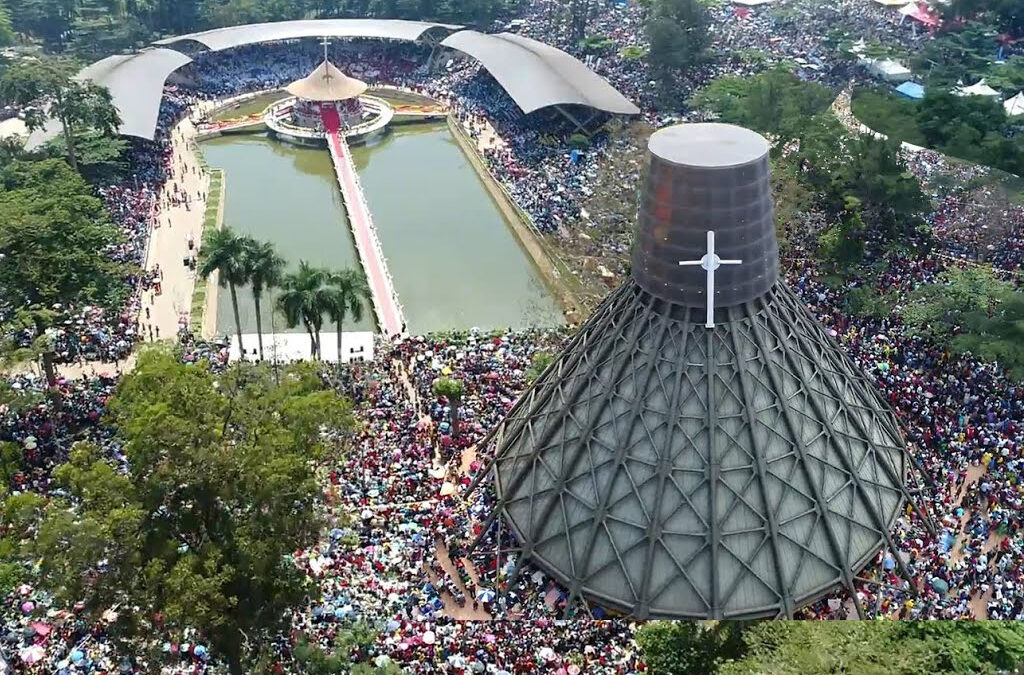
The Basilica of the Uganda Martyrs is the centrepiece of the Catholic shrine. Its distinctive circular design was created to accommodate large congregations while drawing inspiration from traditional African architectural forms. The structure is supported by 22 pillars, representing the 22 Catholic Uganda Martyrs. Inside, visitors can spend time in prayer, attend Mass or view features connected with the story of the martyrs. The Basilica is still an active place of worship, so visits should remain respectful, particularly when services are taking place.
Martyrs Lake
Martyrs Lake is one of the most recognisable features within the shrine grounds. It sits close to the Basilica and becomes especially important during major religious celebrations, when parts of the annual Martyrs Day liturgy take place around the lake. Outside the busy pilgrimage period, the area provides a quieter setting for reflection and gives visitors another perspective on how the shrine has been developed to accommodate both worship and large gatherings.
Shrine Grounds and Pilgrimage Features
The wider grounds include open spaces used for prayer, processions and large pilgrimage gatherings. Visitors can walk around the complex, learn more about the Uganda Martyrs and spend time at different places associated with remembrance and devotion. The grounds are particularly useful for travellers interested in understanding Namugongo as more than a single church building. The Basilica, lake and surrounding pilgrimage spaces together show how the site functions both as a historical memorial and a living centre of Catholic worship.
Uganda Martyrs Day on 3 June
Every 3 June, Namugongo becomes the centre of Uganda Martyrs Day, when pilgrims gather to remember the Christians who were killed for their faith during the persecutions of the late nineteenth century. The date marks the martyrdom of St Charles Lwanga and several of his companions at Namugongo on 3 June 1886. Pilgrims travel from across Uganda and neighbouring countries, with some completing long journeys on foot before reaching the shrine. Masses, prayers, processions and other religious activities take place around the Basilica, Martyrs Lake and the wider pilgrimage grounds.
Visiting Around Uganda Martyrs Day
The days around 3 June are the busiest time to visit Namugongo. Expect large crowds, heavier traffic around Kampala and Namugongo, road diversions and longer transfer times. Travellers coming specifically for the pilgrimage should arrange transport and accommodation well in advance.
Visiting During the Rest of the Year
Outside the annual celebration, Namugongo is much quieter. This is usually better for visitors who want more time to explore the Basilica, Martyrs Lake and shrine grounds, learn the history and experience the site without the large pilgrimage crowds.
Catholic and Anglican Martyrs Shrines at Namugongo
Namugongo has separate Catholic and Anglican martyr sites, and visitors should not treat them as one combined shrine. The Catholic shrine is centred on the Basilica of the Uganda Martyrs, Martyrs Lake and the surrounding pilgrimage grounds. It commemorates the Catholic martyrs and is the main focus of the large annual Catholic pilgrimage on 3 June. The Anglican shrine stands at a separate site nearby and commemorates the Anglican converts who were also killed during the persecutions of the late nineteenth century. It has its own church, memorial spaces and annual Martyrs Day observances. Visiting both sites gives a fuller understanding of the Uganda Martyrs story because the persecution affected Christians from both traditions. For travellers interested in history rather than only a single denomination, the two shrines work well as part of the same Namugongo visit.
How to Visit Namugongo from Kampala
Namugongo lies northeast of central Kampala in Kira Municipality, Wakiso District, making it straightforward to include as a half-day cultural or pilgrimage visit from the city. The exact journey time depends heavily on traffic, especially during weekday rush hours and in the days leading up to Uganda Martyrs Day.
Getting There: Most visitors reach Namugongo by private vehicle, guided transfer, or taxi from Kampala. The shrine is roughly 11 km from Kampala, but the road journey can take much longer than the distance suggests because of urban traffic. If you are visiting as part of a Kampala city tour, Namugongo combines well with other historical and cultural sites in and around the city.
When to Visit: The shrine can be visited throughout the year. For a quieter experience, ordinary weekdays outside major religious celebrations are usually best. Around 3 June, expect large pilgrimage crowds, road controls and significantly heavier traffic. Travellers visiting specifically for Uganda Martyrs Day should allow extra time and confirm current access arrangements before travelling.
Respectful Visits and Photography: Namugongo remains an active place of worship. Dress respectfully, keep noise low around prayer and Mass, and follow instructions given by shrine staff. Photography is generally appropriate in public areas, but avoid interrupting services or photographing people in prayer without permission.
Uganda Martyrs Day on 3 June
Namugongo and the Uganda Martyrs Pilgrimage Route
Namugongo is the best-known site connected with the Uganda Martyrs, but it forms part of a wider pilgrimage story that extends across several locations around Kampala and the former Kingdom of Buganda. For travellers interested in the full history, combining Namugongo with other martyr-related sites gives much better context than visiting the Basilica alone.
Munyonyo Martyrs Shrine
Munyonyo Martyrs Shrine, south of Kampala, is closely connected with the final journey of several of the Uganda Martyrs before they were taken towards Namugongo. The site commemorates events that took place before the main execution at Namugongo and helps explain how the persecution unfolded across different locations rather than at one single site. Combining Munyonyo and Namugongo works particularly well for travellers interested in Christian history, pilgrimage and the wider story of the Uganda Martyrs. Munyonyo provides the beginning of the final journey, while Namugongo represents the principal place of martyrdom and remembrance.
Add Namugongo to a Uganda Safari
Namugongo can fit naturally at the beginning or end of a wider Uganda safari, particularly for travellers spending time in Kampala or Entebbe before continuing to the national parks. A visit works well before travelling towards destinations such as Murchison Falls, Kibale, Queen Elizabeth National Park or Bwindi, adding a cultural and historical experience before the wildlife portion of the journey begins. It can also be included on the final day of a safari when travellers return to Kampala, provided enough time is allowed for city traffic and the onward journey to Entebbe. For travellers interested in faith and heritage, Namugongo can be combined with Munyonyo Martyrs Shrine and other Kampala cultural sites as part of a dedicated city or pilgrimage extension.